

How to Utilyze Gas Data for Winter Demand Response
- Mar 14, 2025
- 8 min read
Updated: Mar 17, 2025
Con Edison’s gas DR pilot was initiated in 2018 addressed winter gas shortages. The three-year pilot offered direct thermostat control for residential customers (up to ~1,000 homes) and incentive payments for large C&I customers who manually reduced gas use on very cold days. This mirrored ConEd’s summer electric DR programs and proved that coordinated thermostat setbacks can flatten gas peaks. Similarly, Southern California Gas piloted a “Seasonal Savings” program in 2017, automatically tweaking 50,000+ smart thermostats (with customer consent) to lower heating use during peak hours.
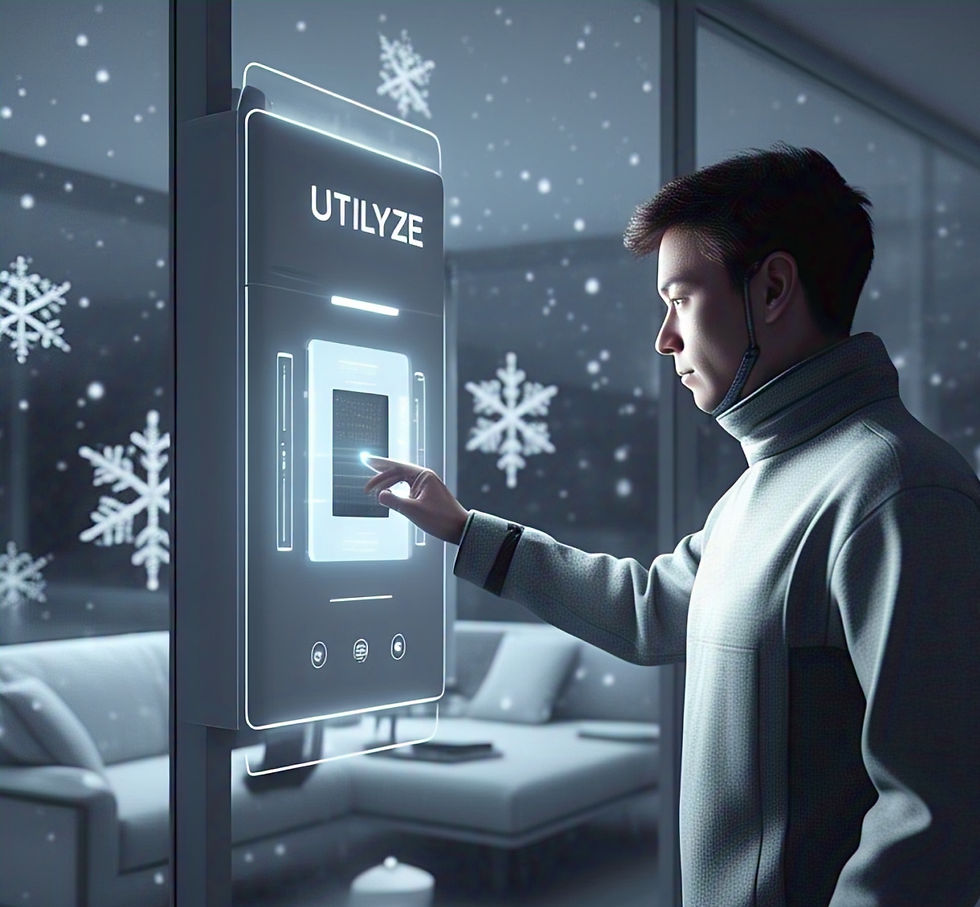
These cases show that leveraging existing DR frameworks for a different season/fuel is feasible, but must be carefully incentivized and communicated due to the critical nature of home heating. Importantly, results from multiple pilots indicate winter DR yields slightly lower per-customer load reductions compared to summer AC events (one utility saw ~0.07 kW saved per customer in a winter morning event vs 0.13 kW in summer afternoon for a PTR program).
Still, when scaled up, these savings can be substantial for system reliability. The key takeaway from all implementations is that winter DR can’t be a carbon copy of summer DR – programs must be custom-tailored to seasonal behaviors and technologies.

Maximizing Customer Engagement
Simplify the customer experience – programs with easy enrollment (or automatic enrollment) and no risk tend to see high uptake. BGE’s opt-out model is one example, while other utilities use incentives like free smart thermostats or bill credits to entice sign-ups. Multiple enrollment channels help reach different customer segments: PGE markets its thermostat program through BYOT (bring your own device via partners like Nest), an online marketplace, and even direct installs for eligible homes.
Broad outreach is crucial; successful programs use mixed media marketing (email, direct mail, social media, bill inserts) to educate customers about the program benefits. Once enrolled, keeping customers engaged is vital – some utilities send seasonal welcome kits with energy-saving tips, and many provide post-event feedback (e.g. a text or email telling the customer how much they saved). This positive reinforcement can increase customer satisfaction and willingness to continue. Additionally, personalization and gamification can boost engagement: for example, showing customers how their peak savings compare to their neighbors’ or setting up friendly competition can motivate extra effort (behavioral science has shown social comparison to be effective in energy programs). Finally, convenience and control are top priorities – always allow participants to easily opt out of an event or override a thermostat adjustment if they feel uncomfortable. Making it clear that they retain control (and can exit the program anytime without penalty) reduces anxiety and builds trust.
Regulatory & Policy Considerations
Regulatory support can make or break DR program implementation, so aligning with policy goals and compliance is important. On the electric side, many states encourage DR through energy efficiency portfolios or peak reduction targets (e.g. Maryland’s past goal of 15% peak demand reduction by 2015 spurred programs like BGE’s. Electric utilities in RTO/ISO markets may also bid DR load reductions into capacity or energy markets, creating revenue to offset program costs.
Regulators often allow cost recovery for DR program expenses and participant incentives, viewing DR as a cheaper alternative to building peaking power plants or T&D upgrades. In BGE’s case, the commission authorized performance incentives tied to peak reduction (allowing BGE to earn returns for successful DR results) aligning the utility’s financial interest with customer benefits. For natural gas DR, regulatory frameworks are emerging. Since gas DR is new, pilots often require explicit commission approval – for instance, the New York PSC approved Con Edison’s gas DR pilot as a $5 million demonstration, one of the first of its kind. Gas utilities must show that DR can reliably shave design-day demand and defer infrastructure (like pipeline expansions) to justify cost recovery. Another consideration is customer protection rules: utilities must adhere to communication regulations (such as the Telephone Consumer Protection Act for texts/calls). Notably, regulators and consumer advocates generally support proactive notification practices for DR. A recent case study noted that opt-out emergency alerts (IVR calls, SMS) had backing from groups like NARUC and the NCLC, recognizing that timely outreach during peak events serves the public interest. Utilities should also use open standards for technology integration – for example, using the OpenADR 2.0 protocol for sending event signals is often recommended to ensure fairness and interoperability.

In summary, successful DR implementations work within regulatory guidelines, often by demonstrating how the program contributes to reliability and customer savings, and by securing explicit program approvals or incentives that make DR a win-win for the utility and its customers.
Consumer Insights & Challenges
Even the best-designed DR program will falter if it doesn’t win over customers. Understanding consumer motivations and barriers is therefore fundamental. Common barriers to participation include: concerns about comfort, loss of control, lack of understanding of the program, and doubts about the benefits. For instance, in winter DR programs, a top concern is “Will my home be too cold if I let the utility curtail my heating?” Many people worry about health and comfort during frigid weather – they might be hesitant to turn down the thermostat or let an algorithm control it. Likewise, in summer, no one wants to be left sweltering without A/C. Another barrier is the perceived loss of control. A notable incident in Texas highlighted this: in 2021, some Houston residents were surprised to find their smart thermostats remotely raised to ~78°F during a heatwave as part of an energy-saving program, and they felt “locked out” of control.
The outrage and media coverage showed that customers must fully understand and consent to any remote control; if they feel things are happening behind their backs, trust is broken. This ties to a broader insight: transparency and consent are crucial for customer acceptance. Additionally, some consumers are simply unaware of DR programs or find the concept too technical. If a program isn’t explained in simple, relatable terms, many will ignore the invitation to join. There can also be inertia or skepticism – “Does my small action really help the grid?” or “Is this just a way for the utility to save money at my expense?” These sentiments can slow enrollment. Finally, technology gaps pose challenges: not everyone has a smart thermostat or reliable internet for connected devices, which can create equity concerns. Early gas DR pilot results have pointed out that relying solely on in-home smart thermostats might exclude some groups and raises questions of fairness if those with tech get incentives while others can’t participate.

Overcoming Barriers & Building Trust
Effective communication and program design can mitigate most of these challenges. First, education is paramount. Utilities should educate customers on why DR matters (“on the hottest/coldest days, reducing demand prevents outages and high costs”) and how the program works (“you’ll get a text the day before asking you to use a bit less, and you can always choose your comfort level”). Successful programs often start with a thorough onboarding: clear terms in plain language, and multiple reminders of what to expect. As one industry expert advises, assume it’s the customer’s first time hearing about the concept – avoid jargon and patiently explain the process.
Emphasize that participation is voluntary and customers remain in control. For example, tell them explicitly that they can adjust their thermostat during an event if they really need to (they just might forgo that event’s incentive), and let them know the maximum number of events per season so they aren’t caught off guard. Providing an easy opt-out path is essential; nothing builds trust more than feeling “I can leave the program if it’s not for me.”
A best practice is to adopt a multi-channel communication strategy from the get-go. Don’t assume one email is enough – people have busy lives. Instead, use layered messaging: send postal mail or an email to introduce the program, use social media or local news to raise awareness, then send SMS reminders during the season. Leverage any customer touchpoint. For instance, some utilities coordinate with device installers or retail partners – when a customer buys a smart thermostat, they get information at checkout or installation about enrolling in the DR program. This captures interested customers at the right moment and shows the program is a normal part of having a smart thermostat.
During the program, maintaining transparency is key. Communicate before, during, and after events. Before an event, remind participants of their options (“If you need to opt out for any reason, just reply STOP…”). During an event, if feasible, send a midway update or post on a portal so customers feel connected (“halfway through the event, thanks for your help!”). After the event, always follow up – thank the participants and show them the impact. For example, an after-event email might say “You reduced your usage by 1.5 kWh and earned $1.50 credit – great job! Collectively, our community cut 20 MW, avoiding potential outages." Seeing tangible results and personal benefit reinforces the value of participation and can turn hesitant users into enthusiastic advocates.
To tackle the comfort issue, program design can offer solutions: in summer, pre-cooling the home before an event and in winter, pre-heating (as PGE does with a 2°F pre-heat before setbacks) can dramatically improve comfort such that many people don’t feel much difference. Communicate these measures: let participants know “we will pre-adjust your home so you stay comfortable.” Also, consider event timing that respects customers’ routines (e.g., a winter morning heating setback might be more acceptable after 8am when many have left for work, versus at 6am when everyone is waking up). Utilities have observed that customers’ thermal tolerance can differ by season – some evidence suggests people may tolerate a slightly cooler home in winter better than a too warm home in summer, so messaging can subtly leverage that (e.g., “grab a cozy sweater and help the community for a couple hours”). For those who still worry, highlight the safety nets: no event will be called during extreme emergencies where heat is critical, and participants can override if someone at home feels unsafe.
Another challenge is the “What’s in it for me?” factor. Here, framing and incentives help. Make the rewards clear: if it’s bill credits, illustrate how much a typical customer earned last season (“the average participant earned $40 last summer”). If the benefit is community-oriented (preventing outages or reducing emissions), appeal to that civic pride (“by joining, you’re helping avoid the need for new power plants and keeping everyone’s bills lower”). Some programs create a sense of community, even naming events as a collective challenge (Jemena in Australia ran “Peak Energy Challenges” to rally customers as a team). This social proof – knowing neighbors are doing it too – can overcome reluctance. Frequent, honest communication also builds credibility: share success stories and testimonials from happy participants (“I was skeptical, but I barely noticed the tweaks and my bill went down”). Over time, as the program delivers on promises (payments made on time, no surprise discomfort, real benefits), trust grows organically.
Lastly, addressing security and privacy concerns can remove barriers for the tech-wary. Utilities should reassure customers that their data is safe and devices secure. For example, explain that all smart thermostat commands are encrypted and that there are limits (manufacturers often cap how far thermostats can be adjusted, etc.). As noted in one report, while grid digitalization raises some cyber concerns, DR devices and platforms have multiple layers of protection to prevent unauthorized access. Communicating these protections (“Your thermostat and our system have industry-standard security and we will never share your personal data”) will ease the minds of those hesitant to connect their devices.

The customer side can clearly make a big impact when it comes to reducing peak load and the data points to a simple truth: make the program as convenient, transparent, and rewarding as possible. By actively listening to customer feedback and removing pain points – whether through better messaging, adjusting event parameters, or improving incentive structures – utilities can foster trust. Overcoming initial skepticism can turn customers into allies who not only participate but encourage others to join. A well-engaged customer base is the cornerstone of any successful demand response program, in winter or summer.


Comments